The Shamisen is one of Japan’s most iconic instruments. Despite being relatively young compared to other Japanese traditional instruments, the Shamisen has been used in countless traditional and modern Japanese songs. Today, many Japanese artists continue to use and promote this iconic instrument.
The Shamisen is regarded as Japan’s Banjo. It has an iconic twang that immediately makes it unique from other stringed instruments. And despite originally being an imported instrument, it has helped shape Japan’s culture. Interestingly, unlike other Japanese traditional instruments, the Shamisen hasn’t changed much in terms of build and structure since landing in Japan.
In this article, we will learn the basics of the Shamisen, its history, and its use in modern Japan. We will also showcase artists specializing in the Shamisen and famous manga and anime featuring the Shamisen.
Shop Japanese Shamisen Now!
What is a Shamisen (三味線)?
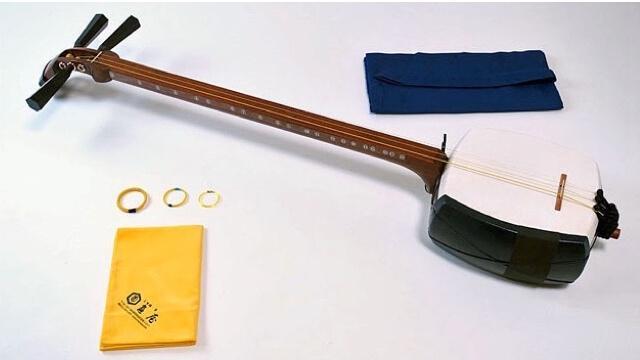
The Shamisen is a fretless Japanese lute with three strings made of silk. The Shamisen is also known as the “sangen” or “samisen” in Japan. All three of its common Japanese names directly translate to “three strings”.
The Shamisen is similar in terms of sound and structure to the Banjo. Like the Banjo, the Shamisen produces a twangy sound. However, the Shamisen’s sound has a more Eastern flavor that has become distinct through its use in traditional Japanese music.
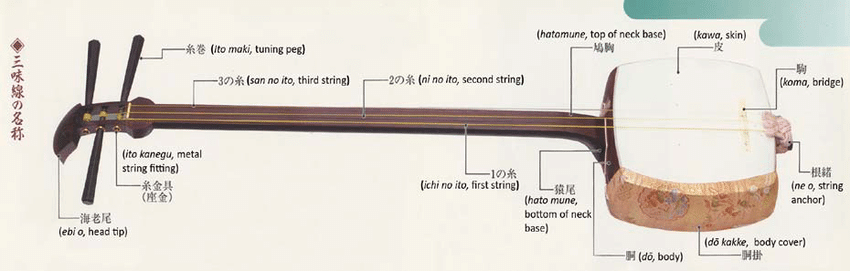
The Shamisen’s distinct twangy sound is called the “sawari”. It is achieved through a groove cut in the Shamisen’s neck near the upper bridge, which causes the lowest string to touch the fingerboard producing its signature buzzing sound.
The Shamisen’s body is known as the dō (胴). It resembles the shape of a drum and has a hollow body construction.
Also Read: How To Order Musical Equipment From Japan
The Shamisen’s body is usually covered by animal skin. The type of skin depends on the genre and the skill of the Shamisen player. Recently, Japanese manufacturers have switched to synthetic materials to replace animal skin on newer Shamisen.
The Shamisen’s neck is known as the sao (棹). It is made of three to four pieces made to fit and lock together. These pieces were designed to be easily disassembled if needed.

The Shamisen’s tuning keys were traditionally made of ivory. But in recent years, Shamisen builders have started using materials such as wood and plastic.
Just like guitars and banjos, different types of Shamisen are built for different playstyles and skill levels. The Shamisen used in more demanding music, such as “kabuki”, have thinner necks. On the other hand, the one used for folk songs and stage plays has a longer and thicker neck.

Shamisen players usually sit on a pillow-shaped futon called a “zabuton”. The instrument is played by plucking or pinching the strings using a plectrum called “bachi”. Different types of bachi achieve different kinds of sound.
Buy Musical Instruments From Japan!
History of the Shamisen
Like many of Japan’s cultural instruments, the Shamisen originally came from China. The Shamisen’s predecessor dates all the way back to the Qin Dynasty’s rule (221 BCE). The three-stringed Chinese instrument was originally known as the “xintao”.

The xintao later became the “sanxian” during the Ming Dynasty’s rule (13th -14th century). Just like the Shamisen that came later, its name directly describes the form and structure of the instrument. The Chinese words “san” and “xian” directly translate to "three" and "strings" respectively.
The sanxian was mostly used to accompany vocal pieces and was rarely used on its own. Like its later incarnations, the sanxian’s body was covered with snakeskin.
Also Read: Introducing The Strange-shaped Japanese Shō Flute
During the 14th century, the sanxian made its way to Japan through the Ryukyu Kingdom, now known as Okinawa. The instrument quickly became popular and evolved into the “sanshin”.
Finally, during the 16th century, the sanshin entered the rest of Japan and evolved into the Shamisen. Compared to its predecessors, the Shamisen used cat or dog skin instead of snakeskin since those materials were easier to acquire.

During the Edo period (17th Century), the Shamisen became incredibly popular in Japan. Initially, the Shamisen only appealed to upper-class citizens. Eventually, commoners and Japanese citizens who lived in rural areas started adopting the instrument.
The Shamisen was so popular that it became an essential skill to learn. Many Japanese people at the time believed that learning the Shamisen helped attract the opposite sex. Many Japanese women learned the Shamisen to help them marry into the house of the upper class.

In addition, the Shamisen was popular among the blind. Playing musical instruments, including the Shamisen, was one of their primary sources of income during this period.
Shop Traditional Japanese Instruments
The Shamisen in Modern Japan
Even today, the Shamisen remains a popular instrument in Japanese music. Many Japanese high schools still teach the Japanese youth to play traditional instruments, including the Shamisen.

Kashiwa Municipal Senior High School is a good example of a school incorporating the Shamisen into its performances. This school is known for consistently winning awards and delivering over 70 performances each year.
Outside of Japanese schools, many Japanese Shamisen virtuosos continue to push the Shamisen to new heights. Shamisen virtuoso Honjoh Hidejiro became a Japan Cultural Envoy in 2021 and has helped connect the Shamisen and Japanese cultural music to a bigger international audience.

Also, the Shamisen is not exclusively used in traditional Japanese music. The Shamisen has appeared in many modern Japanese media, including anime, pop music, movies, and video games.
Shop Anime Soundtracks Now!
Many anime fans might have even heard the sound of the Shamisen without being familiar with the instrument. The Shamisen has been used in the soundtracks of many popular anime, such as Naruto, Demon Slayer (Kimetsu no Yaiba), When They Cry (Higurashi Series), and many more.
The manga and anime series Mashiro no Oto (Those Snow White Notes) uses the Shamisen as the centerpiece of its story. The famous Vocaloid song “Senbonzakura” is well-known for featuring the Shamisen.
Also Read: Traditional Musical Instruments From Japan
Despite the success and recognition of the Shamisen in modern Japanese society, some sources claim that the Shamisen is slowly dying. According to Shamiko Guitars, only 3,400 of the instruments were sold in 2017. Even in previous years, the Shamisen wasn’t selling as many units compared to modern instruments, such as the electric guitar.
Thankfully, companies such as Shamiko Guitars have created modern versions of the Shamisen to keep the instrument alive. The Shamiko is smaller, easier to produce, and has many modern features that allow the Shamisen to be more accessible.
In addition, Canadian Youtuber Norm Nakamura, known for his Youtube channel Tokyo Lens, has been promoting the Shamisen both to Japanese and Western audiences. In addition to becoming the apprentice of the famous shamisen duo the Yoshida Brothers, he has even teamed up with the Japanese Shamisen duo KiKi for live performances, and together they created an online Shamisen school so people can learn to play from anywhere in the world!

The Japanese Rock Band Wagakki Band has also helped invigorate interest in Japanese traditional instruments. This band is popular for combining traditional Japanese instruments, such as the Shamisen and Koto, with modern instruments, such as the drums and guitar.
Also Read: Koto - The Sound of Traditional Japanese Courts
Wagakki Band performed with Evanescence vocalist Amy Lee for a unique rendition of her band's hit song “Bring Me to Life.” This performance went viral, which helped the band achieve international success. It also exposed Japanese traditional instruments to more viewers.
Lastly, Japanese musical software developer Sonica Instruments has released the Tsugaru Shamisen Kontakt Library for music producers and composers. These kinds of software help make the Shamisen more accessible, even to non-Japanese musicians.
Shop Japanese Shamisen Now!
Also Read: BUY FROM WAGAKKIICHIBA