It’s hardly news that Japanese guitar makers are some of the best in the world, and many of the rarest guitars from Japan now fetch considerable sums of money on the resale market.
Indeed, not only do vintage models from brands such as Ibanez, Guyatone, Fernandes and Tokai rank among the rarest guitars ever made, but even now luthiers such as Makoto Sugimoto and Fender Japan’s custom team continue to produce exceptional one-off guitars to order.
In this article we take a look at some of the most unusual, the most innovative, and the rarest guitars from Japan – from the 1960s until the present day.
A Brief History of Japanese Guitar Brands
Japan's guitar-manufacturing industry took off in the 1960s and early ‘70s. At the time many Japanese guitar brands made high-quality replicas of American guitars. As a result, some companies found themselves in hot water for copyright infringement. For this reason the period is often referred to as the "lawsuit era.”
However, while some Japanese luthiers initially reverse-engineered Gibson and Fender guitars, manufacturers like Fujigen and Matsumoku soon matched and even surpassed their American counterparts in expertise, and emulation quickly turned to innovation. Meanwhile, by the mid-70s cost-cutting at American factories led to lax quality control, further tilting the balance in Japan’s favor.
Partially in response to the flood of lookalikes emanating from Japan, in the early 1980s Fender established a Japanese subsidiary in partnership with local manufacturers.
Soon after, Fender’s Extrad and Order Made teams began producing custom guitars for a local market that had come to insist upon exceptional craftsmanship.
At the time, however, the made-in-Japan label still carried a certain degree of stigma abroad. Nonetheless, over the years the excellent craftsmanship of Japanese guitars from this period has become apparent to all, and numerous models from the lawsuit era and beyond are now highly sought after.
By the 1990s, rising local production costs led Japanese brands to shift budget-level manufacturing to Korea or China. Meaning that a “made in Japan” guitar from this period is almost certainly a high-end model.
Since then, Japanese guitar makers have gone from strength to strength, cementing the reputation of Japanese guitars on a global level.
14 of the Coolest, Most Rare Japanese Guitars You Can Find
What follows is a list of some of the best, most bizarre, and rarest guitars from Japan, featuring everything from under-the radar bargains to super hard-to-find vintage guitars and luxury or limited-edition contemporary instruments.
What unites them is that they are all highly coveted by in-the-know collectors and musicians worldwide.
1960s–1980s Vintage Japanese Guitars Worth Collecting
1960s Guyatone Telstar 2
Probably the most outlandish looking model among all the rare Japanese guitars we review here, not only does the Guyatone Telstar 2 feature unparalleled space-age design, but it also delivers admirably in the sound department, too.
With a tremolo that offers plenty of surf-style twang and shimmer, the Telstar 2 seems to have been purposely created for composing Tarantino soundtracks.
Beyond this though, it can also deliver anything from clean and rounded tones, to scratchy indie rock heaven.
1960s Avalon AV-2T

Frank Zappa apparently counted The Shaggs among his favorite bands. Most other people, however, consider them to be one of the absolute worst bands to have existed. Anywhere. Ever.
The Shaggs played Avalon AV-2Ts, though – so they did at least have that going for them.
1968 Teisco May Queen
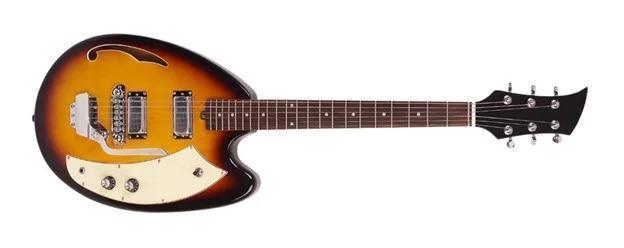
The May Queen is a pretty unique looking guitar; the unapologetically 1960s lovechild of a Vox and a Rickenbacker. However, its distinctive design and high price likely limited its appeal, and it was produced for just one year – making it quite a rarity today.
Not only is the May Queen a very cool-looking instrument, though, but it’s also one that plays beautifully. And the combination of the single coil pickups and hollow-body construction makes for a punchy and biting sound.
So while it may rank among Japan’s rarest guitars, the Teisco May Queen is one that’s well worth tracking down. Especially if you’re in the market for rough and ready vintage garage rock tones at a not too outrageous price.
Mid-to-late 1960s Guyatone LG-200T
The Guyatone Telstar 2 (above) is an eccentric period-piece that ideally requires a similarly eccentric owner to pull it off. Its Guyatone contemporary, the LG-200T, however, sits on just the right side of 1960s futuristic design.
Not only that, but back in the early 00s guitar genius Ry Cooder made an entire album using one of these things, thus propelling the LG-200T to instant cult status. Unsurprisingly, its price tag rapidly followed suit.
Boasting 4 single coil pickups, the guitar has a versatile and unique sound. And in true sixties-gadget style, it also comes with onboard reverb.
1970s Elk Galaxy
Unlike most of the early Japanese guitar manufacturers, Elk produced only for the local market. Meaning that it’s very rare to come across their guitars outside of Japan. Which is a shame, because many are really rather nice.
The Elk brand started out by literally dismantling a Fender Jaguar in order to reverse engineer it, and then went on to produce “homages” to other famous American models.
Unsurprisingly this led to legal threats from Fender’s local representative, and consequently some hasty changes to Elk’s designs.
Before that happened, however, Elk produced a rather excellent Gretsch-style hollow-body called the Galaxy. Just listen to how it sings in the clip above!
Late-70s to early-80s Tokai Silver Star Stratocaster
During the lawsuit years, countless Stratocaster-style guitars emerged from Japan. Many looked the part, but few matched genuine Fenders in playability or sound. And those that did now often cost as much as an actual Fender.
Not so the Tokai Silver Star. At least not yet!
1980 Fernandes Burny FLG 240 Les Paul
As with Strats, there have been numerous Japanese attempts at recreating Gibson Les Pauls. A few of them have come close, too. But there are people who swear that a 1980s Burny FLG 240 not only holds its own in the presence of an original Les Paul, but actually surpasses it.
Just a few years ago you could pick up one of these for a tiny fraction of what a late 1950s Gibson LP Standard would cost you. Now the gap between them has closed considerably, and the FLG 240 ranks amongst the rarest Japanese guitars out there. But let’s be clear; a Burny FLG 240 still represents a total bargain in comparison to a ‘59 Gibson.
Early ‘80s Aria ProII PE-R80
While usually not rated as highly as Ibanez or Tokai, there are in fact many gems among Aria ProII’s catalog from the late 1970s and early ‘80s.
Endorsement of the Cardinal Series from Kurt Cobain – he briefly played a CS-250 – has made this line quite popular. But these were Aria’s entry-level guitars, and Cobain conspicuously upgraded to a Fender the moment he could afford to.
At the other end of the scale, however, is the Aria ProII PE-R80; by no means a budget guitar at the time, and today it typically goes for well over a thousand dollars.
It’s not one of the rarest Japanese guitars on our list, but with its distinctive cloud-motif fretboard, it’s perhaps the most beautiful. It also happens to play extremely well, too.
Modern Japanese Guitar Brands Still Making Rare Models
Strandberg x Sugi ”Master Artist Premium” Limited Edition BodenJ8

To aficionados of rare Japanese guitars, Makoto Sugimoto will need no introduction.
Sugimoto san and his small team at the Sugi workshop in Nagano are behind some of the most sought-after guitars to have been produced in Japan over the last few decades.
Meanwhile, known for their signature headless instruments, Strandberg are arguably Sugi’s Swedish equivalent.
Here the two master luthiers have teamed up to produce an incredible 8-string custom beast in luxurious hardwoods.
Momose MC-MV-PURE WHITE TOCHI SP'24/J
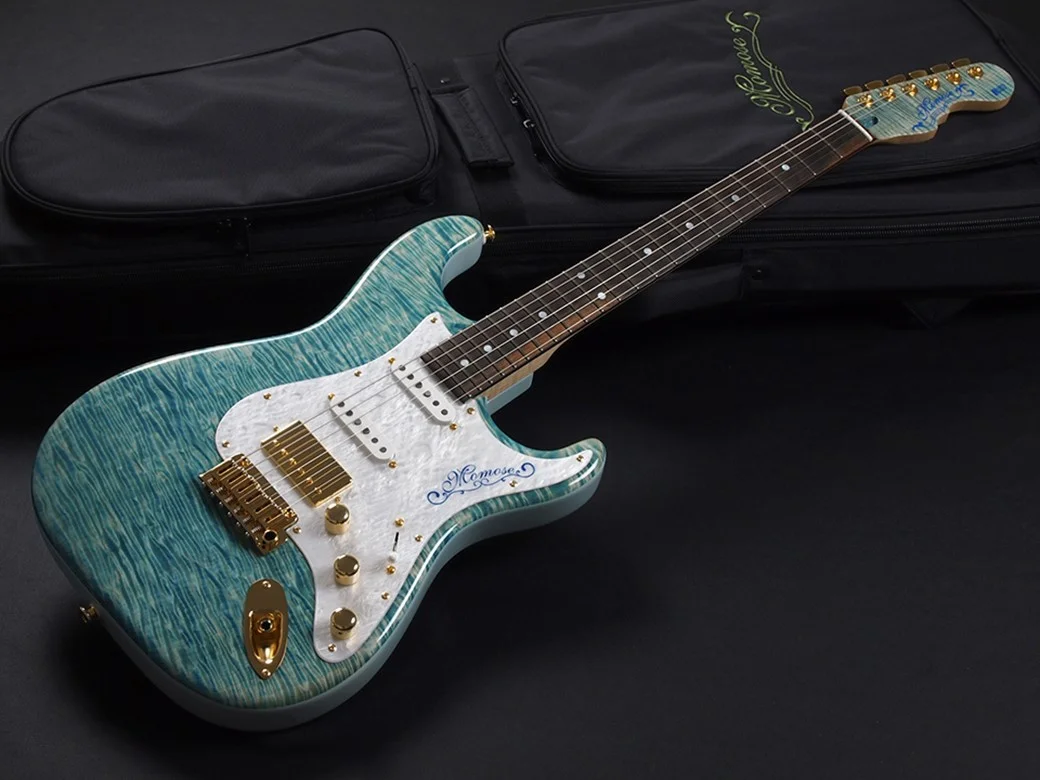
Returning to the present day, precious hardwoods and an uber-limited run of only 12 units make this denim-inspired Strat one of the rarest guitars from Japan currently available on the Digimart website.
ESP STREAM-Miku-Custom - Hatsune Miku 15th ANNIVERSARY Limited Edition
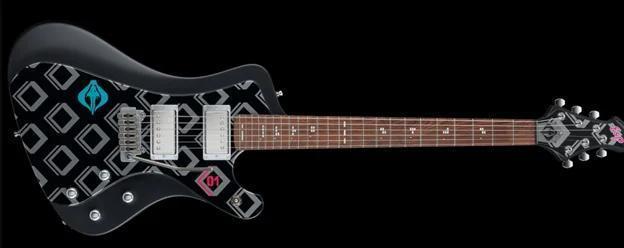
This ultra limited edition model is one of the rarest guitars from Japan ever. But for fans of “virtual idol” Hatsune Miku, it’s essentially the only guitar worth considering. Just as well, then, that it also happens to be a high-specced gem from esteemed Japanese guitar maker ESP.
Fender American Vintage II 1957 Stratocaster – Sea Foam Green
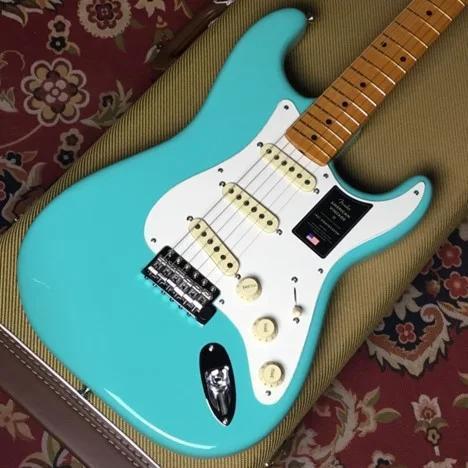
So hyped have vintage 1950s and ‘60s guitars become of late that it seems like most “new” products to hit the market these days are actually recreations of classic models.
That being the case, you might be forgiven for wondering what advantage the American Vintage II 1957 Strat could possibly offer over all the other similar guitars currently available.
But the fact is that this is simply a great quality guitar, with a very smooth and playable neck, and a lovely single-coil tone. Indeed it’s a better all-round choice than most of the alternatives in this oversaturated market.
S21 LTD 51 Nocaster Relic - Aged Nocaster Blonde
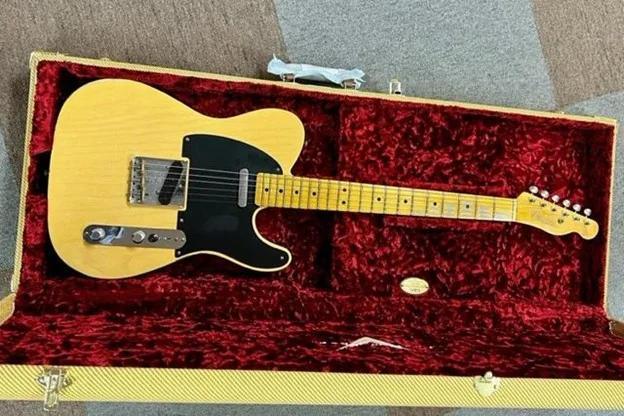
One of the most expensive guitars to sell through Digimart in the last few months is this beautiful LTD 51 Nocaster Relic from the Fender Custom Shop.
For those unfamiliar with the concept of a “Nocaster,” before there were Telecasters, this kind of guitar was originally marketed as a Broadcaster, but the name had to be changed because of a conflict with Gretsch.
What is referred to as a Nocaster was a transition model between Broadcasters and Teles that had no labeling.
Here Fender has faithfully recreated a 1951 Nocaster, complete with original spec and vintage wear-and-tear.
Ibanez J. Custom JCRG GOLD II
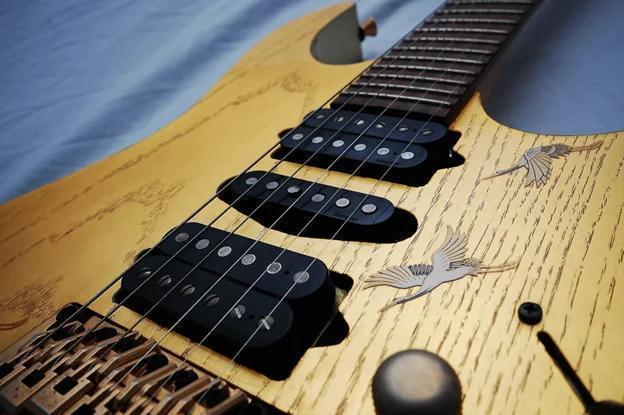
Ibanez GOLD II guitar photo courtesy of Reverb
Not only is this one of the rarest guitars from Japan, but undoubtedly also one of the rarest and most luxurious guitars in the world, period.
Why? Well, firstly the body of the Ibanez GOLD II features six flying cranes in 24k gold. What’s more, there are only 6 of this guitar in existence!
Why Vintage Japanese Guitars Are a Smart Investment
Over the past few decades, vintage Japanese guitars have gone from being affordable alternatives to highly coveted collector’s pieces. Instruments once overlooked as “copies” of American models are now recognized for their exceptional craftsmanship, unique tone, and historical significance.
During the so-called lawsuit era of the 1970s and early 1980s, Japanese brands like Tokai, Greco, Ibanez, and Aria Pro II were producing guitars that often surpassed Fender and Gibson in build quality. Today, these instruments have gained cult status among musicians and investors alike — and their prices have steadily climbed as availability shrinks.
Unlike mass-produced modern guitars, most vintage Japanese models were hand-crafted in limited numbers using aged tonewoods and meticulous attention to detail. This not only gives them distinct character and sound, but also ensures long-term value for collectors who care about authenticity.
In other words, buying a vintage Japanese guitar isn’t just about nostalgia — it’s about owning a piece of musical history that continues to appreciate in both sound and worth. Whether you’re a player, a collector, or an investor, these guitars represent one of the most reliable and inspiring assets in the world of music.
Conclusion
Whether modern or vintage, Japanese guitars rank among the best in the world. And while the cost of vintage Japanese guitars continues to rise, many of the very rarest guitars from Japan are truly exceptional instruments that are well worth the investment.
Digimart is a leading online seller of rare and unusual Japanese guitars. And while it’s not possible for buyers outside of Japan to purchase directly from Digimart, by signing up for an account at ZenMarket we can order any guitar for you, and swiftly ship it to your door.
Register for a free ZenMarket account now, and get instant access to some of the rarest Japanese guitars around!
Have you signed up for ZenMarket yet?
ZenMarket is the place to get your hands on Japanese guitars!
Sign up for FREE now